No Down Payment Car Insurance in California
Get a Quote and Save up 40%!*

Call us 1-855-620-9443
Get a Quote and Save up 40%!*
Auto insurance rates have skyrocketed in recent years. Many drivers are looking for ways to save, like no down payment car insurance in California. Rates across California have surged after insurers raised premiums to offset years of rising repair costs, increased claim severity, higher medical expenses, and increased legal activity.
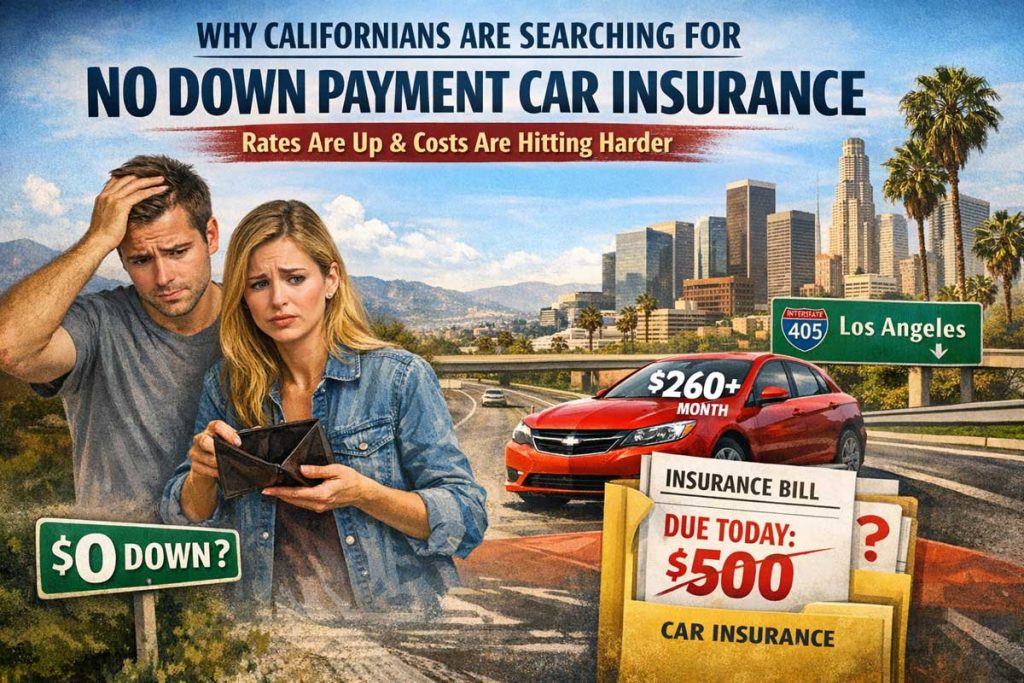
Many drivers saw double-digit increases in 2024 and 2025, and full-coverage policies in cities such as Los Angeles, Oakland, and San Diego now commonly exceed $260 per month. As carriers tighten underwriting rules and raise premiums to reflect higher losses, everyday drivers feel squeezed more than ever.
In this environment, the idea of finding no down payment car insurance in California becomes more than a luxury; it becomes a lifeline. For someone who needs coverage right away in California for as cheaply as possible, the difference between paying $200 today and paying $500 or $600 can determine whether they get on the road legally or not. Many Californians survive on tight pay cycles, and a big upfront insurance bill can derail someone’s monthly budget plans instantly.
Californians often assume a no-down-payment policy means paying nothing upfront, similar to a deferred phone bill or promotional financing. Auto insurance cannot work that way because carriers must collect enough premium at the moment coverage begins to offset immediate risk. A policy starts protecting you instantly, which means the insurer must charge something on day one.
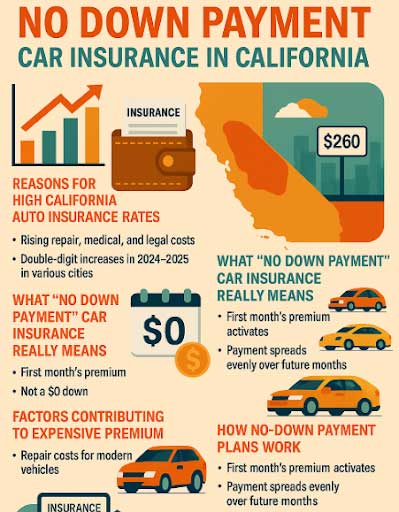
A true no-down-payment policy in California refers to a policy where your first-month premium is the only amount due to activate coverage. There is no added deposit, such as a percentage of the six-month premium. Some companies usually require between ten and twenty-five percent of the term’s cost upfront, but a no-down-payment option eliminates that barrier and spreads the cost evenly throughout the policy.
California’s insurance environment adds complexity because carriers must file their rates with the state under Proposition 103. They cannot adjust premiums freely, so they compensate for risk through tighter underwriting and stricter down-payment rules.
When you see “$0-down insurance” online, it is almost always a marketing simplification that actually means “first-month-only payment.” Realistically, no company will bind coverage without at least collecting that first month.
For California drivers, especially those living in expensive metros, understanding the real meaning of no-down-payment coverage keeps expectations realistic while opening the door to legitimate, affordable solutions.
California recently raised its mandatory minimum liability limits for the first time in decades. Until 2025, the required limits were $15,000 per person for bodily injury, $30,000 per accident, and $5,000 for property damage. These numbers were grossly outdated, given California’s high medical costs and the price of modern vehicles.
Starting in 2025, California’s minimum liability protection increased to $30,000 per person, $60,000 per accident, and $15,000 for property damage. This change alone significantly impacts your first-month payment because the insurer must immediately take on a higher risk. A policy that once covered $5,000 of property damage now must cover triple that amount, and higher limits always translate into higher premiums.
Unlike other states, California is not a no-fault state. Drivers do not carry Personal Injury Protection (PIP), so the system relies heavily on liability coverage and optional Medical Payments protection. This simpler structure may sound cheaper on paper, but California’s medical and litigation environment makes liability claims expensive. That pressure raises premiums and ultimately affects how much you’re asked to pay upfront.
If your goal is to minimize the upfront cost, you might consider carrying only the minimum required coverage. But you must also balance that decision with the realities of California’s accident landscape. A single crash involving even moderate injuries or a newer vehicle can quickly exceed minimum limits. The safest strategy is to select coverage that protects you adequately while structuring your policy in a way that keeps the first payment manageable.
Car insurance in California has never been cheap, but the last few years have made it historically expensive. Several forces combined to raise prices. Repair costs soared as modern vehicles integrated complex technology like collision sensors, LIDAR systems, and advanced driver-assistance software. Even a small fender-bender can now cost thousands to repair. Medical expenses rose statewide, increasing bodily injury claims. Legal activity intensified, with more injury attorneys advertising aggressively and taking on cases that drive settlements upward.
California’s dense urban centers also contribute significantly. Los Angeles has some of the busiest and most congested roads in the nation. San Francisco and the Bay Area bring high theft, vandalism, and accident rates. On top of that, California prohibits insurers from using credit-based insurance scores. While this protects consumers with lower credit, it removes a key pricing factor, making companies rely more heavily on driving record and territory. That shift increases prices for drivers in high-risk zip codes, regardless of their creditworthiness.
When companies face higher expected losses, they tighten their underwriting. That means stricter rules on down payments, fewer exceptions, and less willingness to start a policy without collecting a meaningful portion of the premium upfront. This is why securing a first-month-only payment in California requires strategy, preparation, and targeting the right insurers.
A California insurer offering a no-down-payment option is simply choosing not to charge an additional deposit. You still pay your first month’s premium. The insurer then distributes the remainder of the policy cost evenly across future months. This structure is popular among drivers with good payment histories, clean driving records, and stable risk profiles.
For drivers with complicating factors—recent accidents, DUIs, lapses in coverage, or living in high-theft areas—companies often require a larger first payment to offset immediate risk. Insurance begins providing financial protection instantly, and if a driver submits a claim in the first week, the insurer cannot collect more money afterward. This is why some customers see higher upfront requirements even when the monthly premium appears reasonable.
California insurers also differentiate between minimum-coverage and full-coverage policies. Cars with loans or leases require collision and comprehensive, which raises both premiums and upfront payments. Policies on older, paid-off vehicles are easier to structure with low-down-payment car insurance billing because the insurer has fewer exposure points.
Understanding these billing behaviors helps you navigate the market effectively and avoid unnecessary financial strain.
Drivers with clean histories and continuous coverage are almost always the best candidates for first-month-only plans. If you have no recent accidents, DUIs, or serious violations; if you’ve carried insurance consistently without lapses; and if your vehicle is reasonably priced and garaged in a moderate-risk ZIP code, you stand an excellent chance of activating coverage with only your first month’s payment.
Because California does not use credit scoring, drivers with lower credit scores are not penalized for it. This unique feature of the California marketplace means your driving behavior matters far more than your financial profile when it comes to obtaining flexible billing.
On the other hand, drivers with recent tickets, high annual mileage, vehicles that are costly to repair, or histories of late payments will face higher barriers. Insurers may refuse a no-deposit plan outright for high-risk drivers, insisting instead on a larger upfront payment. A driver with a recent at-fault crash in Los Angeles or a new driver living in a dense urban area may need to prepare for a steeper first-month bill.
Drivers who require an SR-22 filing typically face the strictest payment terms. An SR-22 is not insurance; it is a certificate filed by the insurer with the DMV proving you have the required liability coverage. It is required after offenses such as DUI, reckless driving, or driving without insurance.
Once you require an SR-22, your policy instantly becomes high-risk. Insurers raise rates substantially and often require a larger down payment to activate coverage. Some companies will not offer monthly billing at all, instead requiring a six-month or twelve-month pay-in-full plan. Those that offer monthly billing still tend to demand more upfront than for a standard policy.
In these situations, the priority becomes stabilizing your insurance record. After a continuous period of safe driving and on-time payments, you can often transition out of high-risk carriers, reduce your upfront costs, and eventually requalify for first-month-only structures.
To understand how no-down-payment coverage plays out in the real world, consider a few typical California profiles. A thirty-five-year-old driver in Riverside with a clean record and a six-year-old sedan might see full-coverage premiums around $236 per month. If that driver qualifies for a first-month-only plan, the amount due at signing matches that figure exactly.
A twenty-two-year-old driver in Los Angeles with a newer vehicle and a couple of speeding tickets might pay between $300 and $400 per month. That driver may not qualify for a no-deposit plan and could face a first payment closer to $500 or $600.
Meanwhile, a fifty-five-year-old in Sacramento with a ten-year-old car and low mileage may find liability-only premiums well below $100 per month. These drivers often qualify for very low upfront costs because their risk profiles are favorable.
These examples illustrate how risk, geography, vehicle choice, and driving history determine whether a no-down-payment arrangement is realistic.
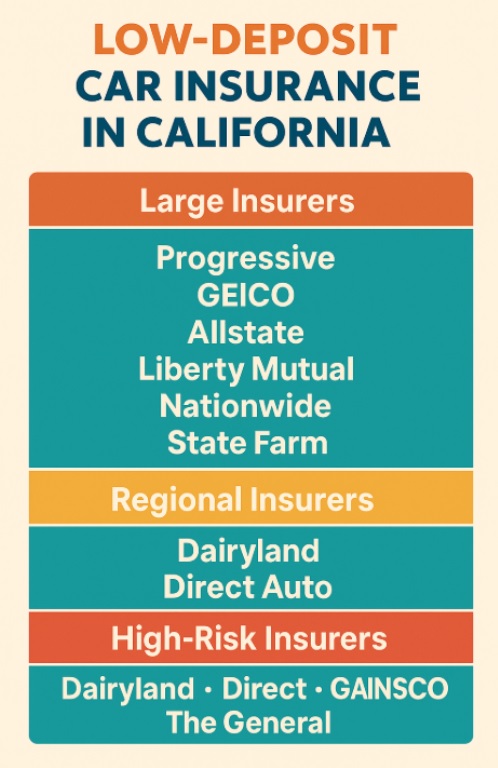
Different insurer categories serve different types of California drivers. Large national carriers such as Progressive, GEICO, Allstate, Liberty Mutual, Nationwide, and State Farm often have billing systems that allow agents to set up first-month-only policies for qualified drivers. These companies rarely advertise such flexibility, but experienced agents know how to structure the application so the driver receives the lowest possible upfront cost.
Regional insurers that focus heavily on California understand the state’s unique claim patterns and regulatory environment. Many offer competitive billing arrangements and may be more forgiving with upfront costs because they specialize in navigating California’s specific risk landscape.
High-risk insurers such as Dairyland, Direct Auto, GAINSCO, and The General serve drivers with DUIs, lapses, or SR-22 filings. They offer monthly payment plans even when standard insurers decline them, though the first payment is often larger. These companies provide essential access for drivers struggling to reenter the insurance market.
Usage-based companies and pay-per-mile programs have become increasingly attractive in California. Low-mileage drivers can dramatically reduce their premiums through telematics, thereby reducing their upfront payment. Progressive’s Snapshot, Allstate’s Milewise, and other usage-based programs allow safe and infrequent drivers to access more favorable billing structures.
Lowering the upfront payment requires strategy, timing, and choosing the right coverage. Deciding which coverages are essential is the first step. Keeping only mandatory liability limits will reduce your first bill, but only if those limits align with your financial risk tolerance. A driver with assets or a long commute may still need higher liability protection to avoid catastrophic financial exposure after a crash.
Providing accurate information during the quote process is essential. California insurers rely heavily on mileage and garaging address, so inaccuracies lead to mispriced quotes and difficulties at claim time. When shopping, obtain quotes from multiple channels—direct carriers, independent agents, and comparison platforms – to ensure you see every available billing pattern.
Always ask about the exact amount due today. Many agents default to quoting policies with deposits unless specifically told otherwise. Once you confirm your quote, you can often reduce the first payment further by enrolling in autopay, signing electronic documents, bundling renters insurance, or participating in a telematics program.
Once you obtain a no-down-payment policy, the key is to maintain continuous coverage. A cancellation for non-payment damages your insurance credibility and hinders your ability to obtain low-upfront options in the future.
Reducing your monthly premium naturally lowers your first-month payment. One of the strongest levers is vehicle choice. Cars that are more affordable to repair, have strong safety records, and are not theft magnets consistently cost less to insure. Choosing the right vehicle can make a dramatic difference.
Reducing mileage also helps. California allows insurers to base rates on annual mileage, so driving fewer miles per year can meaningfully reduce premiums. Carpooling, using public transit when convenient, or consolidating trips can lower your risk profile.
Telematics programs allow safe drivers to earn personalized discounts. Smooth driving habits, gentle braking, and limited nighttime driving can earn reductions that lower both the initial and ongoing costs.
Having continuous coverage is also crucial. Even a short lapse can elevate premiums and eliminate your eligibility for a low-upfront plan.
California’s strict regulations and high consumer demand have created a thriving ecosystem of misleading ads. Many websites claim to offer $0-down policies, but instead collect your data to sell to multiple agencies, often resulting in aggressive marketing and misleading quotes. Some individuals on social platforms pose as agents and request payment through nontraditional channels, only for drivers to discover they have no real coverage.
Sticking with licensed agents and recognizable insurers is the safest approach. A legitimate agent will provide a written quote, explain the coverage clearly, and issue proof of insurance immediately after payment. Avoiding shortcuts prevents fines, impoundment, and long-term financial damage.
Teen drivers face the steepest premiums due to inexperience and higher accident rates. Remaining on a household policy is often the most affordable option. Over time, safe driving habits and telematics participation can reduce costs.
Seniors often enjoy favorable billing because they drive less, have more stable histories, and often own older vehicles. These factors make them ideal candidates for first-month-only structures.
Low-income drivers have access to the California Low Cost Auto Insurance Program, which offers affordable liability coverage to qualifying households. The premiums are low enough that even the first-month payment is manageable.
Rideshare and delivery drivers need specialized endorsements because personal policies exclude commercial use. While these policies cost more, choosing insurers that explicitly support rideshare drivers helps maintain manageable upfront payments.
Non-owner auto insurance is an underrated tool for maintaining continuous coverage. Drivers without a personal vehicle can still protect themselves with liability coverage for occasional use of borrowed or rented cars. These policies are inexpensive and frequently available with minimal upfront cost. They also help drivers maintain an insurance history, which is crucial for obtaining flexible billing later.
A first-month-only policy is ideal when money is tight, and continuous coverage is essential, but it should be paired with careful budgeting. Spreading the cost across the term often leads to slightly higher long-run expenses because of administrative fees. Drivers who can comfortably pay more upfront may prefer to reduce monthly costs. But for many Californians, a no-down-payment plan provides critical flexibility that allows them to stay legally insured and remain mobile.
California’s auto insurance market is complex, expensive, and rapidly evolving. Yet even in a challenging environment, it is possible to secure car insurance with the lowest possible upfront cost. Understanding how billing works, choosing appropriate coverage, maintaining continuous insurance, driving a practical vehicle, and quoting intentionally with the right carriers can make a dramatic difference.
A no-down-payment plan won’t eliminate the cost of insurance, but it can ease the financial strain of getting started, especially when money is tight. For millions of California drivers, that ability to get on the road today, without facing a crushing upfront bill, makes all the difference. Compare no down payment car insurance quotes in California in about five minutes. Start an online quote and see how easy it is to save hundreds with direct rates.