Affordable Auto Insurance in Texas
Company Trusted For Over 25+ Years*

Call us 1-855-371-6683
Company Trusted For Over 25+ Years*
Finding affordable auto insurance in Texas requires understanding what you are legally required to buy, what optional coverages may protect your finances, and how billing structures affect the amount you pay upfront. Texas auto insurance rates have risen sharply in recent years due to higher repair costs, medical inflation, and severe weather claims. For many drivers, the priority is finding a policy that meets state law without creating a financial strain at activation.
This guide explains Texas liability requirements as of 2026, the factors that affect what you pay, and practical steps to compare policies with matching coverage. It does not promise the lowest rate or rank insurers. Instead, it provides a framework for evaluating quotes so you can make an informed decision based on your own profile.
Texas law requires drivers to carry liability coverage to pay for injuries and property damage they cause to others. Effective January 1, 2026, the minimum limits increased under House Bill 4178. Policies issued or renewed on or after that date must meet the new thresholds [citation:2][citation:7].
The current minimum liability limits in Texas are:
These limits are commonly written as 50/100/40. Policies issued before January 1, 2026 may still carry the previous 30/60/25 limits until renewal. The Texas Department of Insurance provides guidance on required coverages and shopping considerations [citation:1].
Minimum liability coverage satisfies the legal requirement to drive. It does not cover damage to your own vehicle, and it may not be enough to pay for serious injuries or damage in a major accident. TDI recommends considering whether higher limits would better protect your savings and income [citation:1].
A liability-only policy pays for injuries and property damage you cause to others, up to your policy limits. It does not include:
If your vehicle is financed or leased, the lender or leasing company will typically require collision and comprehensive coverage. If you own your vehicle outright, the decision depends on its value and whether you could afford to repair or replace it out of pocket.
Texas auto policies also include Personal Injury Protection (PIP) unless you reject it in writing. PIP pays medical costs and certain other expenses for you and covered passengers regardless of fault, up to the policy limit. Rejecting PIP may lower your premium, but it removes that coverage [citation:3].
Insurers price policies based on their assessment of risk. Common factors include:
No single factor determines your rate. Insurers weigh these variables differently, which is why comparing quotes with the same coverage is essential.
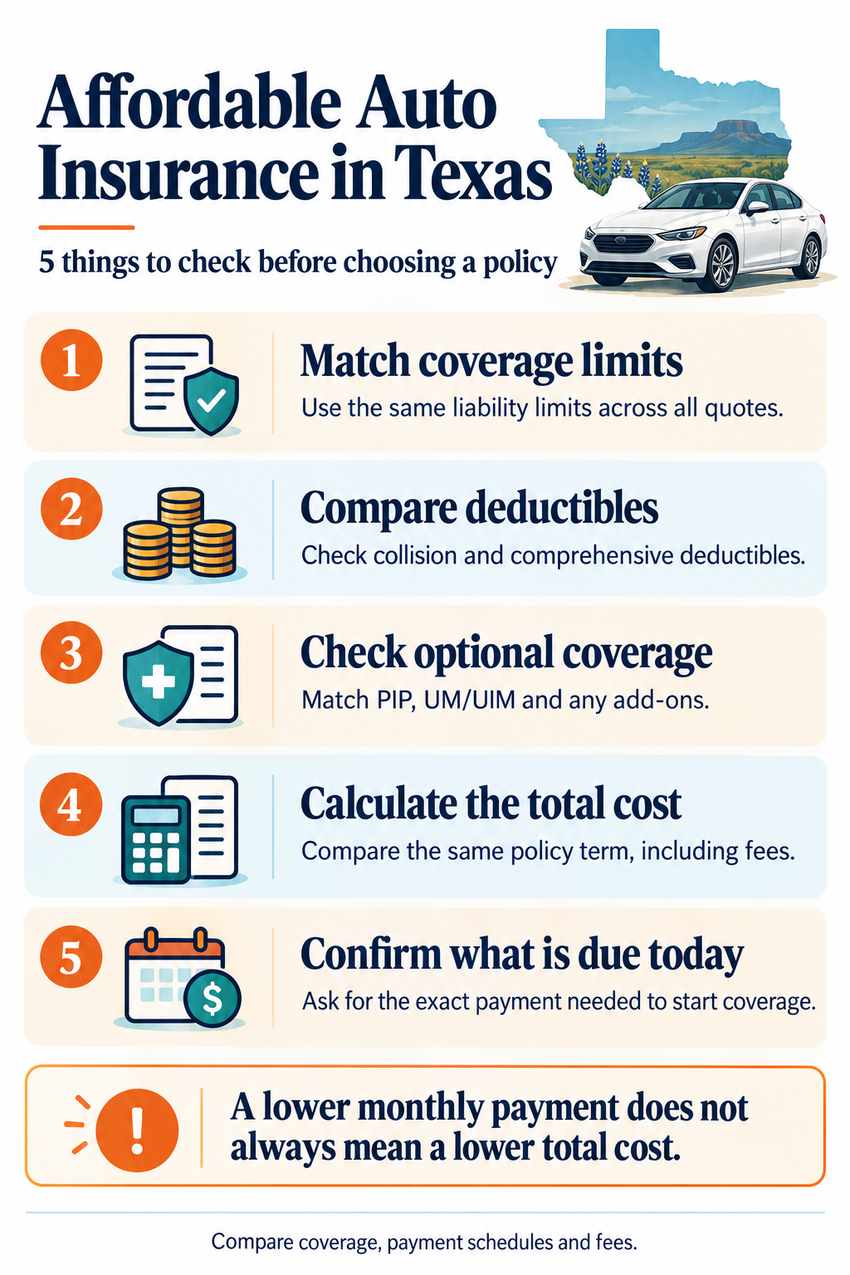
To compare policies accurately, request quotes with identical coverage limits, deductibles, and optional coverages. The table below lists the details to verify on each quote.
| What to Compare | What to Check |
|---|---|
| Liability limits | Confirm the bodily injury and property damage limits on each quote. Use the same limits across all quotes. |
| Deductible | If collision or comprehensive is included, compare deductibles. A higher deductible lowers premium but increases out-of-pocket cost after a claim. |
| PIP selection | Confirm whether PIP is included or rejected. A quote with PIP rejected is not comparable to one with PIP included. |
| Total policy cost | Compare the full premium for the policy term, including installment fees or service charges. |
| Amount due today | Ask for the exact amount required to activate coverage. This may differ from the monthly premium if a deposit is required. |
A lower monthly payment does not always mean a lower total cost. Check the number of installments, any down payment, and all fees before choosing a policy.
Beyond the legal minimum, drivers may choose additional coverages based on their vehicle, finances, and risk tolerance:
Review each option against what you could afford to pay out of pocket after an accident. The cheapest policy is not necessarily the one that leaves you best protected.
Many Texas drivers look for ways to reduce the amount due at policy activation. Legitimate options include:
Be cautious of advertisements promising “zero down” or “free coverage.” Legitimate insurance requires payment to activate coverage. Verify any quote in writing and confirm that the agent or company is licensed in Texas.
Texas minimum liability limits are higher in 2026 than they were previously, but they may still be insufficient after a serious accident. Modern vehicles are expensive to repair, and medical costs for serious injuries can exceed $50,000 per person quickly.
If you have savings, income, or assets that could be at risk in a lawsuit after an at-fault accident, consider whether higher liability limits are worth the additional premium. The difference in cost between minimum and moderate limits is often smaller than the potential financial exposure.
Similarly, if your vehicle is worth more than you could easily replace, collision and comprehensive coverage may be worth evaluating even if they are not required.
For policies issued or renewed on or after January 1, 2026, the minimum limits are $50,000 per person for bodily injury, $100,000 per accident for bodily injury, and $40,000 for property damage. Policies issued before that date may retain 30/60/25 limits until renewal [citation:2].
Yes. A liability-only policy that meets the minimum limits and includes required PIP (unless rejected in writing) satisfies Texas financial responsibility requirements. It does not cover damage to your own vehicle.
Personal Injury Protection pays medical costs and certain other expenses for you and covered passengers regardless of fault. Texas insurers must include PIP unless you reject it in writing. Rejecting it lowers your premium but removes the coverage [citation:3].
Yes, most insurers offer monthly installment plans. Some may charge service fees. The amount due at activation may be only the first month’s premium, or it may include a deposit depending on the insurer and your profile.
Texas insurers may use credit-based insurance scores when pricing policies. These scores are different from ordinary credit scores, and their impact varies by insurer. Maintaining good credit may help lower your premium, but it is not the only factor.
Compare quotes at renewal and every 6 to 12 months, or after changes such as moving, buying a vehicle, adding a driver, or a change in driving record. Use the same coverage limits and deductibles when comparing.
Finding affordable coverage in Texas starts with understanding what you are required to buy and what optional coverages may be worth the cost. Minimum liability limits are higher in 2026, and they still may not cover every situation.
Compare quotes from multiple insurers with matching coverage, ask for the exact amount due today, and review the total policy cost rather than only the monthly premium. A policy that fits your budget and provides meaningful protection is the goal.
For official information about Texas insurance requirements and consumer protections, consult the Texas Department of Insurance at tdi.texas.gov. You can also read a general overview of vehicle insurance on Wikipedia.
>