The Best Pay-As-You-Go Car Insurance
Company Trusted For Over 25+ Years*

Call us 1-855-371-6683
Company Trusted For Over 25+ Years*
With insurance rates rising across the U.S., many drivers are turning to pay-as-you-go car insurance as a way to save money. Pay-as-you-drive auto insurance coverage is an umbrella term people use for two different models: pay-per-mile insurance, where you pay a monthly base rate plus a per-mile charge, and flexible short-term or prepaid insurance, where you buy coverage in smaller time blocks rather than by mileage.
Pay-per-mile insurance is the closest match to the traditional idea of “pay as you drive,” while flexible short-term coverage is better described as “pay for coverage only when you need it.” Although these models work very differently, both are commonly marketed under the pay-as-you-go label.
This guide covers the best-known U.S. insurers that fit into one of these two categories, explains how each option works, who it’s best for, key pros and cons, and then ranks them from typically cheapest to typically most expensive for low-mileage drivers, with important caveats.
A quick reality check before we dive in: there is no universal “cheapest pay-as-you-go insurer.” Your ZIP code, driving record, vehicle, coverage limits, and how you’re measured (miles vs driving behavior vs prepaid periods) can flip the results. Still, patterns do show up, and you can use those patterns to shop smarter.

Pay-as-you-go car insurance is most likely to save you money if:
It may not save you money if:
With that in mind, here are the major pay-as-you-go style insurers.
Metromile is the classic pay-per-mile insurer people think of first. You pay a monthly base rate, then a per-mile rate that reflects how much you actually drive. Historically, Metromile used an in-car device (“Pulse”) for mileage tracking; in many situations today, mileage can be tracked via tech that varies by state and program.
Metromile tends to fit genuinely low-mileage drivers: remote workers, retirees, city dwellers, people with a second vehicle, and anyone who regularly drives well below average.
You’ll see two numbers when you quote:
If you barely drive, the base rate becomes the “floor” of your insurance costs. If you drive more, the per-mile component can push you toward or above traditional insurance pricing.
Ask yourself, “What happens in my ‘busy month’?” If you have a month with several road trips or family visits, run the math with a realistic high-mileage month, not your best-case month.
Allstate’s Milewise is also pay-per-mile, but it’s positioned as a major-carrier alternative with brand recognition and a more traditional insurance ecosystem around it. Like Metromile, you’ll typically see a base rate plus a per-mile charge.
Low-mileage drivers who want a big insurer behind the scenes. If you value bundled products, well-known claims infrastructure, or already like Allstate, Milewise can be appealing.
Base rate + per-mile rate. Tracking can be managed by device or app, depending on your state and how the program is set up.
Compare Milewise not only to Metromile/Mile Auto but also to a “standard” Allstate quote. Sometimes the pay-per-mile option wins; sometimes the regular policy plus discounts is surprisingly competitive.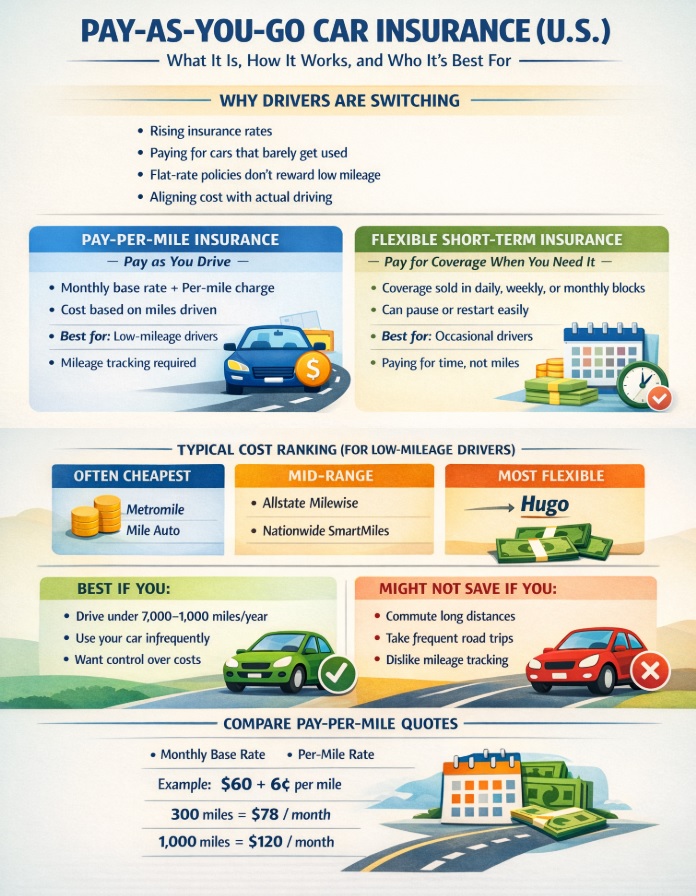
Nationwide SmartMiles is a pay-per-mile option offered under Nationwide’s umbrella. It usually behaves like “traditional insurance with a mileage-based adjustment,” meaning you may have more familiar policy structures while still tying a portion of the cost to miles driven.
Drivers who want a recognized national insurer, and who drive less than average but still want a more mainstream insurance feel than some specialist programs.
Commonly described as a base premium plus a variable portion related to mileage. Tracking can occur via a device or app, depending on availability.
If you drive “low but not super low,” SmartMiles can be a sweet spot. If you drive extremely little, compare it to specialist pay-per-mile quotes where the per-mile rate can be sharper.
Hugo is often discussed in the pay-as-you-go conversation because it offers flexible coverage periods that can be purchased and managed in smaller increments than a standard 6-month policy. This is not usually “pay-per-mile.” It’s more “pay for coverage in chunks.”
Drivers who need maximum flexibility: people between jobs, people who drive only occasionally, drivers who want the ability to pause coverage (where allowed) or buy coverage for specific periods, and those who need insurance with low down payments.
Instead of a base+per-mile structure, you’re commonly choosing coverage and then paying for time blocks. Because it’s built for flexibility, the per-day or per-month cost can look higher than traditional insurance when averaged out, but it can still be useful if you truly need coverage only in certain windows.
If you’re considering Hugo for affordability, also quote a standard 6-month policy with a higher deductible and only essential coverages. Sometimes the boring option is cheaper if you truly need year-round coverage.
Mile Auto is a pay-per-mile specialist that stands out for its simpler tracking approach in many cases. Rather than a constant telematics-style feed, it’s often positioned around periodic odometer reporting (exact method depends on state and program).
Low-mileage drivers who want pay-per-mile pricing without feeling like their driving behavior is being graded. It can be especially appealing if you want a lighter-touch approach than a continuous tracker.
Still typically base + per-mile, but with mileage captured through verification methods that can feel simpler than always-on telematics.
If you’re shopping primarily to avoid invasive tracking, make sure you’re comparing “miles tracking” versus “behavior tracking.” These are not the same thing, and the savings can come with different tradeoffs.
Programs like Snapshot (Progressive), Drive Safe & Save (State Farm), IntelliDrive (Travelers), and similar options from other major insurers are typically usage-based in the sense that they measure driving behavior (hard braking, time of day, acceleration, phone distraction proxies) rather than charging you per mile. They can still reduce premiums, and they are often available in many states, but they’re not the same as pay-per-mile or short-term prepaid insurance.
If your main goal is saving money and you’re open to telematics, it can be smart to compare these too. Just don’t assume “usage-based” automatically means “pay per mile.”
Because pricing changes constantly, treat this as a “typical outcome” ranking for genuinely low-mileage drivers who qualify cleanly and buy similar coverage. Your exact results may differ.
🚗 Often Cheapest for True Low-Mileage Drivers
These two are commonly the sharpest value propositions when you drive very little, because their core business model is built around mileage-linked pricing.
⚖️ Often Competitive, Mid-Range, Depending on Your Profile & State
These can be excellent, but they sometimes price a little higher than specialists for ultra-low mileage drivers, while still beating traditional flat-rate insurance.
💎 Often Most Expensive on an “Apples to Apples, Year-Round” & Best Choice for Flexibility
Hugo can be a lifesaver for payment flexibility, but if you keep continuous coverage, it may average out higher than pay-per-mile or a traditional policy. Where it can win is when your real need is irregular or when the main barrier are car insurance down payments
If you’re comparing pay-per-mile quotes, ask each insurer for:
Then plug in your realistic monthly mileage, including at least one “busy month.”
Below is a visual example demonstrating how this pricing model works (using example rates for illustration only):
📊 Cost Structure: Fixed Base + Variable Rate
Formula: $60 Base + $0.06/mile
300 Miles/Month
Base: $60
Mileage: $18 (300 × $0.06)
$78 Total
($0.26 per mile)
1,000 Miles/Month
Base: $60
Mileage: $60 (1,000 × $0.06)
$120 Total
($0.12 per mile)
Key Insight: Higher mileage spreads the fixed cost, reducing cost per mile. This is why mileage honety matters so much.
If you’re trying to decide whether this category fits you at all, here’s the big picture.
Start with your “driver type,” then match the insurer.
If you drive very little and want maximum savings, start with Metromile and Mile Auto, then compare to Milewise and SmartMiles. If you drive low to moderate miles and want a major-carrier feel, compare Milewise and SmartMiles, then back-check with specialist quotes.
If your core problem is cash flow or you need short-term flexibility, look at Hugo, but also compare against a stripped-down traditional policy. If you hate tracking, you may still tolerate odometer-style verification better than behavior telematics, but if you can’t tolerate any tracking, pay-as-you-go may not be your category.
Below are 10 common questions people have when shopping for pay-as-you-go car insurance.
Pay-as-you-go car insurance can be a legit money-saver if you drive less than average and you’re willing to verify mileage. If you’re truly low-mileage, specialist pay-per-mile programs often make the most mathematical sense because their pricing is designed around low usage.
Major-carrier pay-per-mile programs can be a strong middle ground when you want a bigger brand and broader infrastructure, even if the pricing isn’t always as sharp for ultra-low miles. Flexible short-term products can be useful when your primary concern is cash flow or short coverage windows, but they can become expensive if kept active year-round.
The fastest way to avoid being misled by “pay as you go” marketing is to compare every option on the same basis: base rate, per-mile rate (if applicable), and your actual monthly miles, including at least one busy month. When you run that math, the right choice usually becomes obvious. Compare the cheapest pay-as-you-go car insurance quotes online and save more money on the coverage you need.