Prepaid Auto Insurance Coverage
Company Trusted For Over 25+ Years*

Call us 1-855-371-6683
Company Trusted For Over 25+ Years*
With insurance costs increasing all over the U.S., many drivers are looking for alternative ways, like prepaid car insurance, to save money. Prepaid auto insurance is currently a small niche but increasingly popular alternative to traditional 6- or 12-month car insurance policies.
Instead of committing to a long policy term with a large upfront payment or fixed monthly bill, prepaid auto insurance allows drivers to pay for coverage in advance, often in smaller, more flexible increments.
This model appeals to drivers who value flexibility, struggle with large down payments, or don’t need continuous year-round coverage. However, prepaid insurance is not always cheaper – and in some cases, it can cost more if used incorrectly.
This in-depth guide explains how prepaid auto insurance works, its benefits and drawbacks, costs, the top insurers offering it, who it’s best for, smart ways to save money, and answers the most common questions.
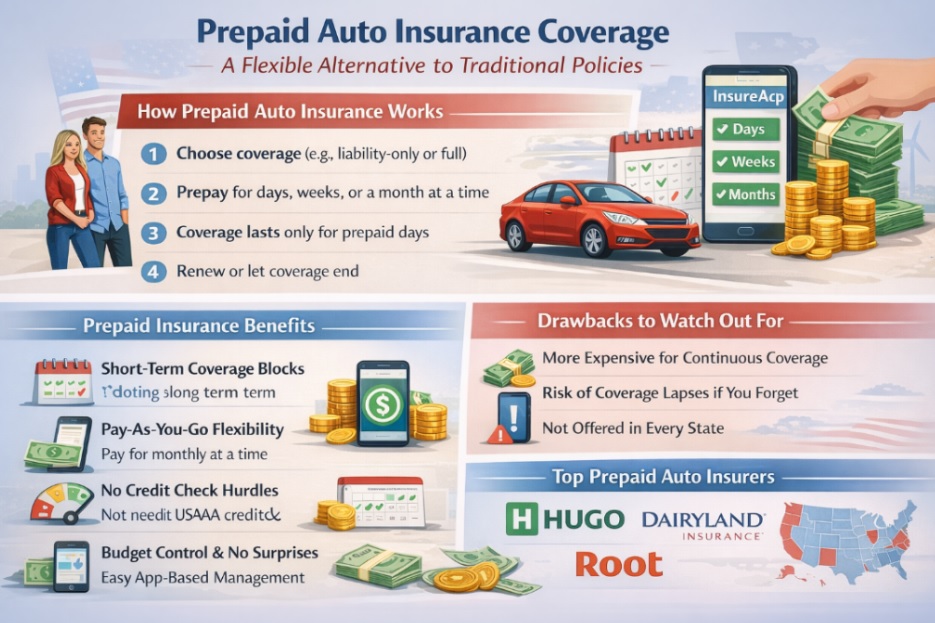
Prepaid auto insurance means you pay for coverage before you use it, rather than being billed after coverage is already in force. Coverage can be purchased in daily, weekly, or monthly blocks, depending on the insurer and state rules.
This is different from traditional auto insurance, which usually requires a 6- or 12-month commitment, pay-per-mile insurance, which charges based on miles driven, and usage-based insurance, which adjusts rates based on driving behavior.
Prepaid insurance focuses on time-based flexibility, not mileage or driving habits.

While each insurer structures it differently, the general process looks like this.
Some insurers allow easy pause and restart of coverage, no long-term contracts, and app-based management. Others require continuous coverage to avoid penalties and advance renewal to prevent lapses.
Prepaid insurance removes the need for large down payments or locked-in monthly bills. This can be helpful for drivers with variable income or cash-flow challenges.
Ideal for drivers who drive occasionally, own a secondary vehicle, or need insurance temporarily due to a new job, relocation, or vehicle storage periods.
Some prepaid insurers rely less on credit-based pricing than traditional carriers, making coverage more accessible to drivers with limited or damaged credit.
Because you pay upfront, there are no surprise bills. You know exactly what you’re spending before coverage begins.
Most prepaid insurers operate digitally, allowing users to start, stop, and manage coverage from a phone without speaking to an agent.
If you maintain continuous coverage all year, prepaid insurance often ends up more expensive than a standard policy.
If you forget to renew or prepay on time, coverage stops immediately. Even short lapses can increase future insurance costs.
Prepaid auto insurance is not offered in all states and often has strict eligibility rules.
Some prepaid insurers limit coverage, add-ons like roadside assistance, and eligible vehicle types or driver profiles.
Costs vary widely, but drivers typically see daily prepaid coverage priced higher per day than traditional insurance, monthly prepaid coverage costing more than a standard monthly installment, liability-only policies being significantly cheaper than full coverage, and higher-risk drivers paying noticeably more per period.
Prepaid insurance tends to make the most financial sense only when you truly need short-term or intermittent coverage.
Hugo is the most recognized prepaid auto insurance provider in the U.S. It allows drivers to buy coverage in small time increments and manage everything through an app.
Dairyland doesn’t market itself strictly as prepaid insurance, but it offers pay-in-full and short-term-friendly policies for higher-risk drivers.
Root is sometimes grouped with prepaid insurers because it emphasizes app-based management and upfront pricing, though it is technically usage-based coverage rather than prepaid.
Prepaid auto insurance tends to work best for drivers who don’t use their car every day, people between jobs or relocating, seasonal workers, owners of secondary or recreational vehicles, drivers who struggle with large down payments, and people who want short-term legal compliance.
It is usually not ideal for daily commuters, high-mileage drivers, households needing stable continuous coverage, and drivers who frequently forget renewals.
Sometimes the cheapest move is using prepaid insurance strategically, not permanently.
Prioritizes flexibility and cash flow control.
If your driving needs are irregular, prepaid insurance can make sense.
Prioritizes long-term cost efficiency and stability.
If you need coverage every day of the year, traditional insurance almost always wins on price.
Prepaid auto insurance fills an important gap in the insurance market. It’s not designed to replace traditional auto insurance for everyone, but for the right driver in the right situation, it can provide flexibility, accessibility, and short-term affordability that standard policies don’t.
The key is honesty about your driving habits and coverage needs. If flexibility is your top priority, prepaid insurance can be a useful tool. If long-term savings matter most, a traditional policy is often the better choice. Compare prepaid auto insurance plans in minutes and save big with direct online rates.