Last updated on April 2, 2026
By
RodneyDYoung.net Editorial Team
— Insurance & consumer guidance contributors
▾
The RodneyDYoung.net Editorial Team produces informational content about auto insurance topics, focusing on plain-language explanations of coverage options, pricing factors, and common policy questions.
Articles clarify common terms (such as deductibles and limits) and typical shopping considerations to help readers compare options more confidently.
Content reviewed internally for clarity and consistency of general insurance concepts.
Note: This content is for general informational purposes only and does not constitute insurance, legal, or financial advice. RodneyDYoung.net is an independent informational website and is not affiliated with any insurer.
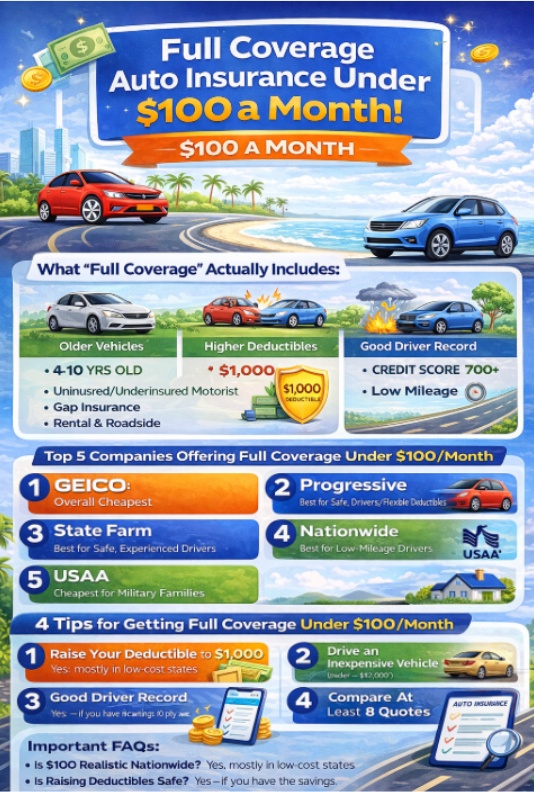
Full coverage auto insurance under $100 a month sounds unrealistic to many drivers, but in the right circumstances, it absolutely is possible. While full coverage is more expensive than liability-only insurance, millions of drivers across the U.S. maintain comprehensive protection without exceeding the $100 monthly mark.
The key is understanding what “full coverage” really means, how insurers price risk, and which levers you can pull to lower costs without exposing yourself financially. This guide breaks down exactly how full coverage pricing works, who qualifies, which insurers are most competitive, and what strategies actually work in the real world.
What “Full Coverage” Auto Insurance Actually Includes
Contrary to popular belief, “full coverage” is not a specific insurance product. It’s a term used to describe a policy that typically includes:
Liability insurance
Covers bodily injury and property damage you cause to others.
Collision coverage
Pays to repair or replace your vehicle after an at-fault accident.
Comprehensive coverage
Covers non-collision damage such as theft, vandalism, fire, hail, flooding, falling objects, and animal strikes.
Optional add-ons may include:
- Uninsured/underinsured motorist coverage
- Rental reimbursement
- Roadside assistance
- Gap insurance (for financed vehicles)
Because full coverage protects your vehicle, insurers care deeply about your car’s value, your driving habits, and your likelihood of filing a claim.
Why Full Coverage Costs More Than Liability-Only Insurance
Liability-only policies are cheap because the insurer isn’t responsible for your vehicle. Full coverage introduces two major cost drivers:
💰 Vehicle value
The more your car is worth, the more expensive it is to insure.
📊 Claim frequency
Comprehensive and collision claims happen more often than liability claims.
That said, older vehicles, higher deductibles, and low-risk drivers dramatically reduce those costs – sometimes enough to bring full coverage below $100 per month.
Who Can Realistically Get Full Coverage Auto Insurance Under $100 a Month?
Drivers most likely to qualify share several traits:
- Clean driving record (no recent tickets or accidents)
- Vehicle worth under $12,000–$15,000
- Credit score above 700
- Low annual mileage (under 10,000 miles/year)
- Willingness to carry a $1,000 deductible
- Lives in a moderate- or low-cost insurance state
Drivers who finance or lease vehicles are often required to carry full coverage, making affordability especially important.
The Most Important Factors That Control Full Coverage Pricing
This is the single biggest factor
A 6–10-year-old vehicle with a market value under $10,000 is the sweet spot. The insurer’s maximum exposure is limited, so premiums drop sharply compared to newer vehicles.
Vehicles that tend to be cheapest to insure:
- Four-door sedans
- Small to mid-size SUVs
- Four-cylinder engines
- Non-luxury brands
biggest factor
🚗📉
Mileage Has a Massive Impact on Rates
Drivers who commute less or work remotely are statistically less likely to file claims.
Driving under 800 miles per month often unlocks:
- Low-mileage discounts
- Usage-based pricing programs
- Reduced comprehensive risk
low mileage = savings
💸📈
Deductibles Matter More Than You Think
Raising your deductible from $500 to $1,000 can reduce full coverage premiums by 15%–30%.
For drivers with emergency savings, a higher deductible is one of the fastest ways to reach the $100/month target.
15–30% savings
💳📊
Credit Score (In Most States)
In states where allowed, drivers with strong credit pay significantly less for full coverage. Insurers associate higher credit scores with lower claim frequency.
credit matters
Top 5 Insurers Most Likely to Offer Full Coverage Under $100 a Month
While no insurer guarantees this price, the following companies consistently offer some of the lowest full coverage premiums for qualified drivers.
GEICO — Overall Cheapest for Full Coverage
GEICO frequently ranks as the
cheapest national insurer for full coverage on older vehicles. Its pricing model heavily rewards clean driving records and low mileage.
Best for:
Drivers with strong credit
Older vehicles
High deductibles
Urban and suburban drivers
Many qualified drivers see full coverage quotes between $75 and $95 per month.
Progressive — Best for Telematics and Deductible Flexibility
Best for:
Drivers willing to use telematics
Drivers raising deductibles
Drivers with mixed insurance history
State Farm — Best for Experienced Drivers
State Farm is extremely competitive for drivers over 40 with long, clean driving histories. Its accident-free discounts are strong and stable over time.
Best for:
Seniors
Long-term policyholders
Multi-policy households
Nationwide — Best for Low-Mileage Drivers
Nationwide’s
usage-based programs are especially attractive for drivers who rarely commute. Many retirees and remote workers qualify for very low full coverage rates.
Best for:
Retirees
Remote workers
Low-mileage households
USAA — Cheapest for Military Families
For eligible drivers, USAA often undercuts every competitor on full coverage pricing.
Best for:
Active duty military
Veterans
Military families
Can You Get Full Coverage Under $100 on a Financed Vehicle?
Yes – but conditions must be right. Most lenders require:
- Collision and comprehensive
- Deductibles no higher than $1,000
- Continuous coverage
To stay under $100 on a financed vehicle:
- Choose an affordable used vehicle
- Avoid luxury brands
- Shop aggressively across insurers
- Eliminate unnecessary add-ons
Leased vehicles are generally harder, as leasing companies often require lower deductibles.
Teens and Full Coverage Under $100 a Month
For teens, full coverage under $100 a month is extremely rare—but not impossible when bundled correctly. The only realistic path involves:
- Staying on a parent’s policy
- Driving an older, low-value vehicle
- High deductibles
- Good student discounts
- Telematics programs
- Clean driving behavior
A teen on their own policy almost never qualifies for this price.
Seniors and Full Coverage Under $100 a Month
Seniors are the most likely age group to qualify. Why?
- Lower mileage
- Decades of driving experience
- Fewer risky behaviors
- High policy stability
Many seniors easily maintain full coverage for $70–$95 per month, especially on older vehicles.
When Full Coverage Is NOT Worth It
Even if you can afford it, full coverage doesn’t always make financial sense. Consider dropping full coverage if:
- Your vehicle is worth under $3,000
- Annual premiums exceed 10% of the car’s value
- You can replace the vehicle out of pocket
In those cases, liability-only coverage may be the smarter financial move.
Choosing the Right Coverage Limits
While full coverage protects your vehicle, liability limits protect your assets. Experts commonly recommend:
- At least 100/300 bodily injury limits.
- Property damage limits aligned with vehicle values in your area
Cutting liability limits too aggressively to save money can expose you to lawsuits far exceeding your premium savings.
Discounts That Make Full Coverage Affordable
Stacking discounts is often what pushes full coverage below $100. Common discounts include:
- Safe driver
- Accident-free
- Low mileage
- Defensive driving course
- Multi-policy bundling
- Automatic payments
- Telematics participation
- Vehicle safety features
Many drivers qualify for multiple discounts without realizing it.
Why Comparing Quotes Is Non-Negotiable
No single insurer is the cheapest for everyone. Full coverage pricing varies wildly based on internal risk models. Drivers who compare 8–10 quotes routinely save:
- $300–$500 per year
- Sometimes even more
Online quoting takes minutes and often reveals surprises—both good and bad.
Frequently Asked Questions
Q: Is full coverage under $100 a month realistic nationwide? +
A: Yes, but it’s easier to find in lower-cost states and usually harder in dense urban markets where premiums tend to run higher.
Q: Does raising my deductible really help that much? +
A: Yes. Raising your deductible is one of the most effective ways to lower premiums quickly, as long as you can comfortably afford the higher out-of-pocket cost if you file a claim.
Q: Is telematics worth it? +
A: For safe drivers, absolutely.
Usage-based tracking programs can lead to solid savings, though poor driving habits may result in higher rates instead.
Q: Can I drop full coverage later? +
A: Yes. You can usually adjust your coverage at renewal, and many drivers choose to do so after paying off an auto loan or when the car’s value drops.
Q: What’s the fastest way to lower my full coverage premium? +
A:
Start by comparing quotes, raising deductibles, reducing annual mileage if applicable, and removing optional add-ons you don’t really need.
The Final Word On Full Coverage Auto Insurance Under $100 a Month
Full coverage auto insurance under $100 a month is not a gimmick—it’s a math problem. When vehicle value, driver behavior, coverage choices, and insurer selection align, affordable full protection is well within reach.
The smartest drivers don’t just look for cheap insurance. They look for efficient insurance coverage that protects their finances without wasting money.
If you approach full coverage strategically, $100 a month is not the ceiling. For many drivers, it’s just the starting point. Compare full coverage auto insurance plans in under 5 minutes and save big with direct rates.