Prepaid Auto Insurance Coverage
Company Trusted For Over 25+ Years*

Call us 1-855-371-6683
Company Trusted For Over 25+ Years*
With insurance costs increasing across the U.S., many drivers are looking for more manageable ways to pay for coverage. “Prepaid auto insurance” is an informal term commonly used for policies that require payment before coverage applies. In most cases, it does not describe a separate type of insurance or a standalone daily policy. It may refer to paying a standard 6- or 12-month car insurance policy in full or, in limited cases, funding coverage in smaller increments.
Instead of making a large upfront payment or following a fixed monthly schedule, some flexible-payment programs allow drivers to fund coverage in smaller advance increments. The underlying policy may still have a conventional term.
This model may appeal to drivers who value payment flexibility or struggle with large down payments. However, prepaid insurance is not necessarily cheaper, and registered vehicles generally must remain continuously insured under applicable state rules. Drivers should not turn coverage on and off merely because they are not driving regularly.
This guide explains what prepaid auto insurance means, how flexible-payment arrangements work, their benefits and drawbacks, potential costs, available examples and alternatives, and the questions drivers should ask before buying coverage.
Prepaid auto insurance generally means paying some or all of the premium before the corresponding coverage period. The term can refer to paying the full premium for a conventional policy or using a flexible-payment policy that deducts the cost of active coverage from a prepaid balance.
It should not automatically be interpreted as a standalone daily, weekly, or one-month policy. Short-term auto insurance is not widely available as a distinct product in the United States.
Prepaid payment arrangements are also different from pay-per-mile insurance, which considers mileage, and usage-based insurance, which may use driving behavior to help determine the premium.

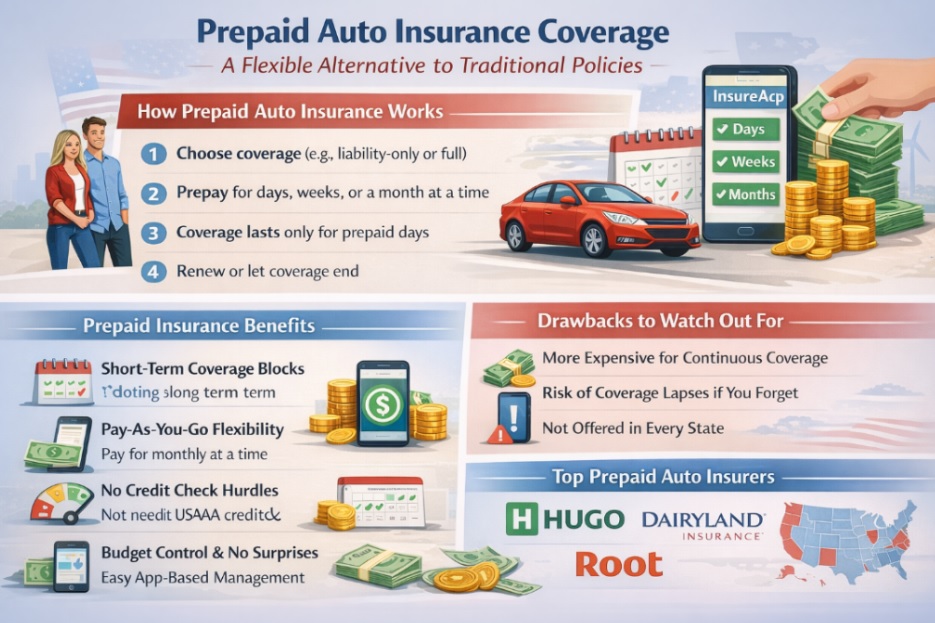
While each insurer structures it differently, the general process looks like this.
The details vary significantly. For example, Hugo describes its Basic plan as a standard 6-month liability policy with flexible payments. An initial payment may fund only a few days, but the underlying policy is still a 6-month policy. Hugo also states that it currently does not offer full coverage.
Benefits
Some prepaid payment arrangements may reduce the initial payment required to begin coverage. This can be helpful for drivers with variable income or cash-flow challenges, but it does not guarantee a lower total premium.
Some flexible-payment arrangements let eligible drivers begin a policy by funding a relatively small number of days. This affects how the premium is paid; it does not necessarily make the policy itself short-term insurance.
A smaller initial payment may help drivers with limited cash flow. However, insurers may still consider credit-based insurance scores where state law permits, so prepaid arrangements should not be assumed to avoid credit-related rating factors.
Advance payments can make upcoming charges easier to anticipate. Drivers should still review the total policy premium, fees, balance requirements, and renewal terms before enrolling.
Some flexible-payment programs are managed online or through an app. Features vary, and app-based policy management does not necessarily mean that a driver can pause coverage without cancellation or legal consequences.
Drawbacks & Limitations
A small initial payment does not establish that the total policy cost is lower. Compare the complete term premium and any fees with conventional payment options.
Failure to maintain the required balance or make a payment can lead to cancellation, subject to the policy and state rules. A lapse may affect future premiums and can create registration, lender, or legal problems.
Prepaid auto insurance is not offered in all states and often has strict eligibility rules.
Flexible-payment programs may offer fewer coverage choices or impose eligibility restrictions. For example, Hugo currently states that it does not offer comprehensive and collision coverage.
There is no reliable national average specifically for “prepaid auto insurance,” partly because the term describes payment arrangements rather than a standardized coverage product. Your premium will still depend on factors such as your state, ZIP code, driving history, age, vehicle, coverage limits, and deductibles. Liability-only coverage generally provides less protection than a policy that also includes comprehensive and collision coverage, so the prices are not directly comparable.
Paying a conventional policy in full may qualify for one of the discounts available from some insurers. A low initial payment, however, does not necessarily mean a lower total premium. Compare the total policy cost, including installment or payment fees, rather than only the amount required to begin coverage.
Hugo is one of the clearest examples of flexible prepaid auto insurance payments. Its Basic product is a standard 6-month liability policy, while eligible customers may initially fund as little as several days. The company currently states that it does not offer full coverage.
Dairyland offers conventional policy terms with options that may include paying the premium in full, making a down payment, or using monthly installments. This can help manage payment timing, but it is not the same as purchasing daily prepaid coverage. See Dairyland’s description of its payment options; availability and terms vary by state.
Root is not a prepaid insurer. It uses smartphone-based telematics and driving behavior as important rating factors, while its app provides policy-management functions. It belongs here only as an alternative for drivers comparing technology-based insurance options.
A flexible prepaid-payment arrangement may be worth considering for drivers who need to reduce the initial amount required to start a policy, receive income on an irregular schedule, can closely monitor their prepaid balance and renewal requirements, and need liability coverage in a state where the product is available.
It may not be suitable for drivers who need comprehensive and collision coverage, tend to miss payments, or could create a registration or lender violation by allowing coverage to lapse.
The lowest initial payment is not necessarily the lowest-cost option. Compare identical coverage over the same period before choosing a payment arrangement.
Prioritizes flexibility and cash flow control.
A flexible prepaid balance may help drivers manage a smaller initial payment, but the underlying policy may still have a conventional term.
Prioritizes long-term cost efficiency and stability.
For continuous year-round coverage, compare the prepaid arrangement’s total term cost with conventional policies. A flexible initial payment should not be assumed to produce a lower overall premium.
Flexible prepaid payments may address a cash-flow gap for some drivers, but they should not be confused with widely available standalone short-term insurance. The payment arrangement does not change the need to carry coverage that complies with state law and, when applicable, lender requirements.
The key is to compare equivalent coverage and the full policy-term cost. If payment flexibility is your priority, a prepaid arrangement may be worth considering where available. Compare available auto insurance options by total premium, coverage limits, deductibles, fees, and cancellation terms—not solely by the first payment.