$20 Weekly Car Insurance
Company Trusted For Over 25+ Years*

Call us 1-855-371-6683
Company Trusted For Over 25+ Years*
If you need to insure a vehicle for only a few days, the idea of $20 weekly car insurance may sound appealing. The problem is that advertisements and search results do not always make clear whether $20 represents the full cost of seven days of coverage, an initial payment or an installment on a longer policy.
This guide examines whether one-week car insurance is actually available, what an advertised $20 rate may include and which alternatives could provide suitable protection when genuine seven-day coverage cannot be found.
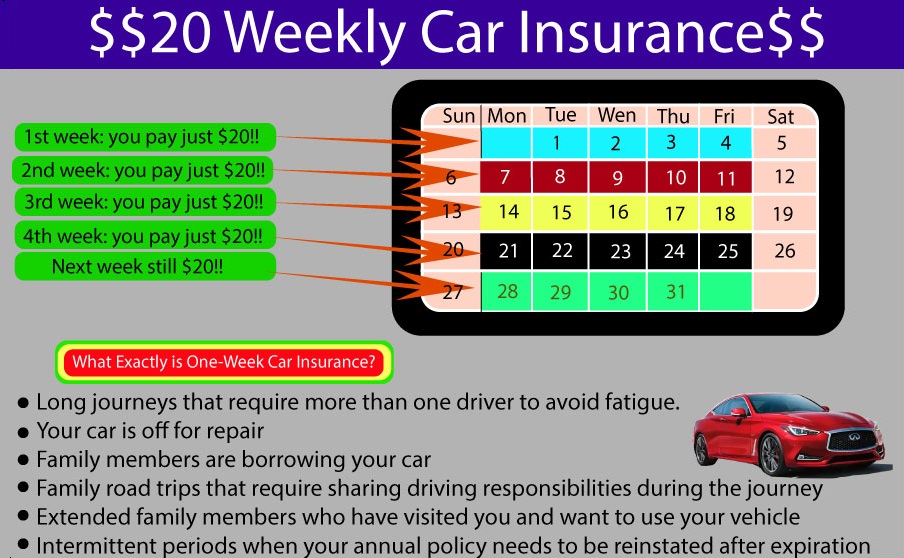
For the purposes of this guide, $20 weekly car insurance means short-term auto coverage intended to remain in effect for approximately seven days, with prices advertised as starting around $20. It is aimed at drivers seeking coverage for a limited period rather than a conventional six- or twelve-month policy.
This type of coverage should not be confused with a weekly installment on a longer policy, a $20 down payment or the weekly equivalent of a monthly premium. Those arrangements describe how a premium is presented or paid; they do not mean that the insurance expires after seven days.
One-week auto policies are uncommon among major U.S. insurers, and the advertised $20 price is not guaranteed. Availability, eligibility and cost depend on the state, provider, driver, vehicle and selected coverage. Before buying, confirm the policy’s effective and expiration dates, total premium, coverage limits and applicable fees.
A weekly payment does not necessarily mean that an insurance policy lasts for only one week. A provider may divide the premium for a six- or twelve-month policy into installments, but the underlying policy remains a longer-term contract.
By contrast, a genuine one-week policy would begin on a specified effective date and expire approximately seven days later. This distinction matters because stopping an installment payment does not automatically convert a conventional policy into temporary coverage or cancel it without consequences.
Most major insurers do not advertise policies limited to seven days. Both Allstate’s temporary insurance guide and Progressive’s explanation of temporary car insurance indicate that major carriers generally do not offer policies lasting only a few days or weeks.
If you purchase a conventional six- or twelve-month policy and later cancel it, the insurer may refund part of the unused premium. However, cancellation rules, fees and refund calculations vary. Ending one policy without replacement coverage can also create an insurance lapse, which may result in higher rates later.
Drivers may look for one-week or temporary car insurance in situations such as:
These circumstances do not always require purchasing a separate seven-day policy. For example, an existing policy may cover permissive drivers who borrow the insured vehicle occasionally. The vehicle owner should confirm this with the insurer because exclusions, household-driver rules and coverage limits vary.
Drivers in California can also review these temporary car insurance options and alternatives. Requirements differ by state, so information for one jurisdiction should not be applied automatically in another.
There is no universal eligibility rule for weekly auto insurance because it is not a standardized product offered under identical conditions by every insurer. Eligibility depends on the policy and provider. Insurers commonly consider factors such as:
A particular age range or valid license does not guarantee approval, access to a seven-day policy or a $20 rate. Visitors from outside the United States should verify whether their foreign license is accepted and whether applicable coverage is available through a rental company, travel insurance product or another authorized provider.
If the primary difficulty is the amount required before coverage begins, drivers can compare low-down-payment car insurance plans. However, these are alternatives to weekly coverage. A low initial payment should not be mistaken for the price of a seven-day policy.
A policy lasting approximately seven days may be available through certain specialized providers or under limited circumstances. However, there is not enough evidence to describe $20 one-week car insurance as a widely available product, and no provider can guarantee that price for every driver.
The advertised $20 amount may be a starting price, promotional claim or amount that applies only to a narrowly defined driver profile. It may also exclude fees or require conditions that are not immediately apparent in the advertisement.
Before assuming that an offer provides a complete week of coverage for $20, ask the provider to confirm:
Drivers who cannot find genuine one-week coverage may need to consider a conventional policy with a flexible payment arrangement. Options such as $20 down payment car insurance and other low initial payment options address the upfront cost of starting a policy, but they do not provide seven days of coverage for a total price of $20.
There is no reliable nationwide rate for a one-week auto insurance policy. The advertised $20 price should be treated as a starting claim rather than a guaranteed premium. Actual availability and cost depend on the provider, state, driver, vehicle and coverage selected.
A quote may be influenced by:
Pay-as-you-go and usage-based programs may reduce costs for some low-mileage drivers, but they are not automatically one-week policies. Their premiums may include a base charge, a mileage component or adjustments based on recorded driving behavior.
Before enrolling, review how mileage is measured, what driving data the program collects and whether the policy remains active between trips. You can learn more about pay-as-you-go car insurance before comparing this alternative with a standard or short-term policy.
Do not compare quotes using price alone. Two policies with different liability limits, deductibles, exclusions or optional coverages are not equivalent.
The coverage is determined by the actual terms of the policy, not by the advertised $20 price. Depending on the insurer and state, a policy may include:
Some short-term offers may provide only the minimum liability coverage required by the state. Do not assume that collision, comprehensive or roadside assistance is included merely because the policy allows you to drive legally.
Auto insurance requirements are established at the state level. Most states require drivers or vehicle owners to demonstrate financial responsibility, commonly through liability insurance, but the required limits and permitted alternatives are not identical nationwide. Personal injury protection is not mandatory in every state.
Drivers should check their state insurance department or motor vehicle agency instead of relying on a single nationwide coverage list. For example, someone shopping for liability car insurance in Illinois should review the requirements that apply specifically in Illinois.
If genuine seven-day auto insurance is available in your state, it may offer practical advantages for drivers who need coverage for only a limited period. The actual benefits depend on the provider and policy terms and should be confirmed before purchase.
These potential advantages do not mean that a weekly policy is always the best or least expensive option. Compare its total premium, limits, exclusions and fees with alternatives such as being added temporarily to an existing policy or purchasing applicable rental vehicle coverage.
Major insurers may offer monthly installments, usage-based programs or low initial payments, but that does not establish that they sell seven-day policies for $20. Availability must be confirmed directly with each insurer or licensed agent.
When comparing companies, ask these specific questions:
Optional services should also be evaluated separately from the base policy. For example, these guides explain Allstate roadside assistance and Nationwide roadside assistance. Their inclusion here does not mean that either company offers a $20 seven-day insurance policy.
If you rent a vehicle for a week, first determine whether you already have applicable coverage. Possible sources include:
These options are not interchangeable. A personal auto policy may extend some coverage to a rental vehicle, while a credit card benefit may cover only certain types of physical damage. Neither should be assumed to cover liability, personal belongings, administrative charges or the rental company’s loss-of-use claim.
Before declining the rental company’s coverage, contact both your insurer and card issuer. Ask what is covered, which exclusions apply and whether the benefit is primary or secondary.
Because genuine one-week policies are uncommon, one of the following alternatives may be more realistic:
None of these alternatives should automatically be described as weekly auto insurance. The appropriate option depends on who owns the vehicle, how long it will be driven and whether the driver already has access to another applicable policy.
Before paying for any plan promoted as “$20 weekly car insurance,” verify:
Be cautious if a website does not identify the insurer, promises the same price to every applicant or describes a payment as the total cost without displaying the policy term. A quote is not the same as active insurance coverage.
Do not drive until the licensed provider confirms that the policy is active. Completing an online form, submitting personal information or receiving an estimated price does not itself establish insurance coverage.
A one-week policy may be useful when a driver genuinely needs coverage for only a few days. However, $20 weekly car insurance should not be treated as a widely available or guaranteed product. Before purchasing it, verify that the policy actually lasts approximately seven days and compare its total cost and protection with the available alternatives.
If the real problem is not the duration of coverage but the inability to pay the full premium upfront, a flexible payment arrangement may be more relevant. Drivers in that situation can review car insurance with flexible payment options, while remembering that delayed or installment payments do not turn a conventional policy into seven-day insurance.
The best option depends on why you need temporary coverage. Someone renting a car, borrowing a vehicle or driving only a few miles per month may need different forms of protection. Compare the total cost, exact policy duration, coverage limits and exclusions—not just the amount displayed in an advertisement.
If you decide to compare quotes through RodneyDYoung.net, keep in mind that the site is not an insurance carrier and does not issue policies. It connects consumers with insurance providers, which determine the final price, policy term, payment schedule, eligibility and available coverage. Confirm these details with the licensed provider before purchasing a policy.